
Marketing has changed fast in the AI era. Tasks that once took marketers weeks now happen in minutes. AI powers personalized recommendations, 24/7 chatbots, and smarter campaign targeting, quietly reshaping how brands connect with customers.
That’s why “AI marketing” is such a hot topic right now. According to recent industry benchmarks, 87% of marketers now use generative AI in at least one recurring workflow (Salesforce State of Marketing).
Marketers are adopting AI not just to keep pace with competitors, but because it makes campaigns faster, smarter, and measurably more profitable—in fact, AI-driven campaigns generate 22% higher ROI and 32% more conversions than traditional campaigns (McKinsey & Company).
The productivity boost is equally dramatic: marketers save 6.1 hours per week on routine, manual tasks (HubSpot State of Marketing), while reducing content production time by up to 63% (Searchlab AI Marketing Statistics).
This guide breaks down what AI marketing means, how it’s used across the customer journey, and practical tips to help you get started even without a tech background.
What is AI Marketing?
AI marketing refers to the use of artificial intelligence technologies like machine learning, natural language processing, and predictive analytics to plan, execute, and optimize marketing efforts. In simple terms, it’s about using smart software to understand customers better and make marketing decisions faster than humans can alone.
Technically, this involves algorithms that analyze large volumes of data such as browsing behavior, purchase history, demographics etc to identify patterns and predict outcomes.
These systems can then automate tasks like audience segmentation, content personalization, and ad bidding in real time. Instead of relying on gut instinct or static rules, AI marketing uses continuous learning models that improve their accuracy the more data they process, making campaigns more precise and responsive.
How AI Marketing Works
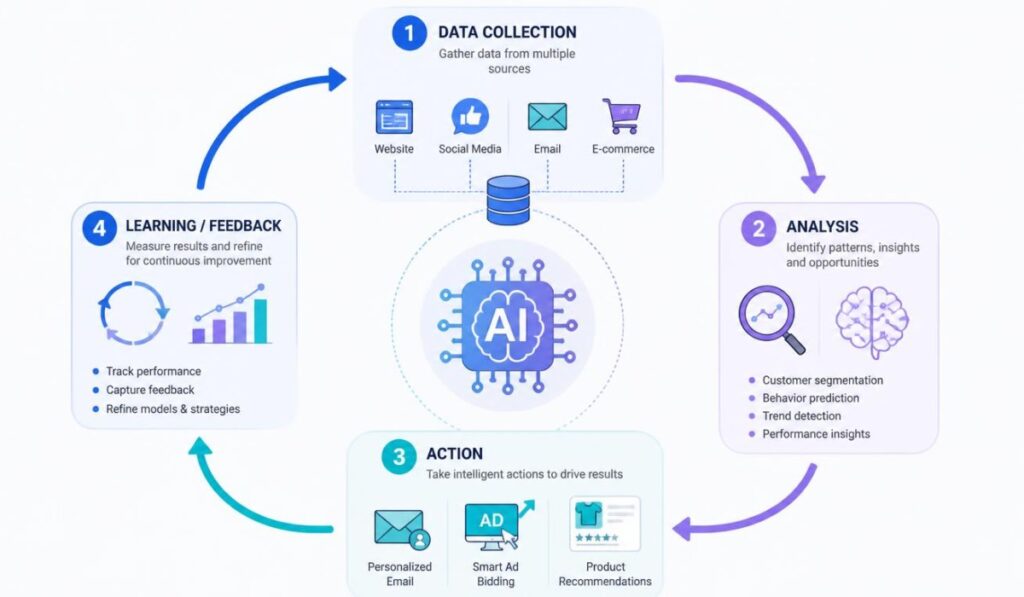
AI marketing follows a basic cycle: data collection, analysis, action, and learning. First, AI tools gather data from multiple sources such as websites, social media, email interactions, and purchase history. Next, machine learning algorithms analyze this data to identify patterns, such as what content a customer engages with or when they’re likely to buy.
Based on these insights, AI systems take action like sending a personalized email, adjusting an ad bid, or recommending a product. Finally, the system tracks the results of these actions and feeds that data back into the model, allowing it to refine its predictions over time. This feedback loop is what makes AI marketing increasingly accurate and efficient the longer it’s used.
Why AI Marketing Matters
The sheer volume of customer data being generated today across websites, apps, and social platforms has become too massive for humans to analyze manually. AI steps in to process this data explosion and turn it into actionable insights in real time. As per McKinsey 76% users are explicitly more likely to buy from brands that personalize their interactions (McKinsey & Compan)
At the same time, customers now expect brands to know their preferences, their timing, their needs. This rising bar for personalization means generic, one-size-fits-all campaigns no longer cut it; AI makes it possible to tailor messaging to individual users at scale.
AI also dramatically speeds up campaign execution, automating tasks like A/B testing, ad targeting, and content optimization that would otherwise take days or weeks. This speed, combined with sharper data-driven decision-making, gives AI-powered brands a real competitive advantage that helps them respond to market shifts faster and outperform competitors still relying on traditional methods.
Traditional Marketing vs AI Marketing
| Aspect | Traditional Marketing | AI Marketing |
| Decision-making | Based on human intuition, past experience, and manual data review | Driven by data analysis, algorithms, and predictive modeling |
| Speed | Slower; campaigns take days or weeks to plan and adjust | Near real-time; decisions and adjustments happen instantly |
| Personalization | Broad audience segments with generic messaging | Individual-level personalization based on behavior and preferences |
| Scalability | Limited by team size and manual effort | Easily scales across millions of customers simultaneously |
| Cost | Higher long-term costs due to manual labor and slower results | Higher upfront investment, but lower ongoing costs and better ROI |
| Human involvement | Heavy reliance on marketers for every decision | Humans focus on strategy while AI handles execution and optimization |
What AI Can do in Marketing?
1. Generative Content Creation
AI tools can produce marketing assets in seconds, helping teams scale their output without necessarily increasing staff.
- Copywriting: Drafting emails, blog posts, ad copy, social media captions, and landing page text.
- Visuals: Creating images, graphics, and even video content based on simple text prompts.
- Adaptation: Translating content into different languages or reformatting the same message for various platforms (e.g., turning a blog post into a series of tweets).
2. Hyper-Personalization at Scale
AI enables marketers to treat every customer as an individual rather than part of a broad segment.
- Recommendation Engines: Like those used by e-commerce sites to suggest products based on a user’s purchase history and browsing behavior.
- Dynamic Messaging: Customizing email subject lines, product offers, and ad messaging in real-time based on individual preferences.
- Tailored Experiences: Adjusting website content or app interfaces based on the specific needs or profile of the person visiting.
3. Data-Driven Decision Making & Analytics
AI can analyze data patterns far faster than any human, providing actionable insights that improve ROI.
- Predictive Analytics: Using historical data to forecast future outcomes, such as which customers are likely to purchase, which might churn (leave), or what the customer lifetime value (CLTV) will be.
- Performance Tracking: AI-enhanced dashboards can link campaign success to specific tactics, highlighting exactly what is working and what needs adjustment.
- Reporting: Automating the creation of reports, slide decks, and data visualizations, which saves hours of manual work.
4. Ad Campaign Optimization
AI has redefined digital advertising by automating the technical aspects of media buying.
- Programmatic Advertising: Automatically buying and placing ads in real-time to target specific audiences.
- Budget Management: Platforms like Google Performance Max or Meta Advantage+ use AI to dynamically adjust bids and shift budgets toward the channels and creatives that deliver the highest return on investment.
7. Automating Repetitive Tasks
By handling the “heavy lifting” of routine marketing tasks, AI allows teams to focus on high-level strategy and creativity.
- Scheduling & Segmentation: Automatically segmenting email lists, scheduling posts, and updating customer records.
- Process Automation: Reducing human error in data entry and campaign setup, ensuring that campaigns follow consistent rules and processes.
Here is interesting video on Use of AI for Businesses that you must check out:
Real-World Examples of AI Marketing d
Amazon’s Product Recommendations
Amazon analyzes browsing history, past purchases, and similar customer behavior to suggest products you’re likely to buy. This “customers who bought this also bought” feature is one of the earliest and most successful examples of AI-driven personalization.
Netflix’s Content Suggestions
Netflix uses AI to analyze viewing patterns and recommend shows or movies tailored to each user’s taste. This keeps viewers engaged longer and reduces the time spent searching for something to watch.
Spotify’s Personalized Playlists
Spotify’s “Discover Weekly” and “Daily Mix” playlists use AI to analyze listening habits and recommend new music that matches individual preferences. It’s a prime example of AI enhancing user experience through personalization.
Google Ads Smart Bidding
Google uses machine learning to automatically adjust ad bids in real time, aiming to maximize conversions within a set budget. This removes the guesswork from manual bidding and improves campaign performance.
ChatGPT-Assisted Content Creation
Marketers increasingly use AI tools like ChatGPT to draft blog posts, social captions, and ad copy quickly. This speeds up content production while allowing human writers to focus on refining and personalizing the final output.
Benefits of AI Marketing
For Businesses
AI marketing drives higher ROI through smarter budget allocation, improved conversion rates, and reduced operational costs.
For Marketing Teams
It automates repetitive tasks—like reporting and campaign optimization—freeing up time for teams to focus on strategy and creative work.
For Customers
AI creates more relevant, personalized experiences, from tailored recommendations to faster customer support.
Is AI Replacing Marketers?
Despite common fears, AI isn’t replacing marketers—it’s augmenting them. AI excels at processing data, automating repetitive tasks, and identifying patterns, but it lacks the human intuition needed for strategic thinking, brand storytelling, and understanding cultural nuance.
Humans still play an essential role in setting marketing strategy, crafting creative campaigns, and making ethical judgment calls. Like ensuring messaging is authentic and doesn’t cross into manipulative territory. AI simply can’t replicate the emotional intelligence and contextual judgment that great marketing requires.
Key Takeaways
- AI marketing uses machine learning, predictive analytics, and automation to make marketing faster, smarter, and more data-driven.
- It works through a continuous cycle of data collection, analysis, action, and learning, improving over time.
- AI matters because of the data explosion, rising customer expectations, and the need for personalization at scale.
- Compared to traditional marketing, AI offers greater speed, scalability, and cost-efficiency.
- AI powers nearly every marketing function—from content creation and SEO to customer service and forecasting.
- Real-world examples like Amazon, Netflix, Spotify, and Google Ads show how AI already shapes everyday customer experiences.
- AI marketing benefits businesses, marketing teams, and customers alike, driving efficiency and better experiences.
- A wide range of tools now support AI-driven content, email, SEO, design, CRM, and analytics needs.
- AI augments—not replaces—marketers; human strategy, creativity, and judgment remain essential.
- The future belongs to teams that combine AI efficiency with human expertise for the best results.
Frequently Asked Questions
How can I do AI marketing?
Start by identifying repetitive or data-heavy tasks in your current marketing process—like email personalization, content creation, or ad targeting. Then, adopt AI tools suited to those tasks (such as ChatGPT for content or Mailchimp for email automation) and gradually integrate them into your workflow while monitoring performance.
What is an AI marketing strategy?
An AI marketing strategy is a plan that outlines how a business will use AI tools and technologies to achieve specific marketing goals, like improving personalization, boosting conversions, or automating campaigns.
Is there an AI marketing course?
Yes, many platforms like Coursera, HubSpot Academy, and Google Skillshop offer beginner-friendly courses on AI marketing, covering tools, strategy, and practical applications.
Pros and cons of AI in marketing?
Pros include faster execution, better personalization, and improved ROI. Cons include potential data privacy concerns, upfront costs, and the risk of losing the human touch if over-relied upon.
What are AI marketing tools?
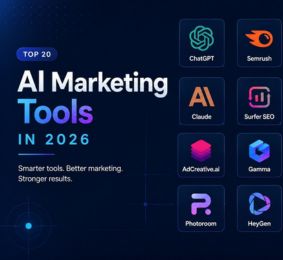
Popular tools include ChatGPT and Jasper for content, Surfer SEO for search optimization, Mailchimp for email, Canva for design, Salesforce Einstein for CRM, and Google Analytics for data insights.